Since it began, 2D animation has been the method used for many famous films and although today the use of 3D animation is starting to rise, it still remains hugely popular with viewing audiences around the world.
 |
| Cavemen early 'animation' paintings |
In 1650, the Magic Lantern was created which is often debated as the first visual use of 2D animation. The basis of the Magic Latern is that of a projector with several slides which would appear on a surface, such as a wall, when placed in a dark room with light inside the lantern. As the slides moved, the 'animation' became apparent. Despite being a huge part in 2D animation history, the creator of the Magic Latern is unknown and still questioned today.
 |
| Example of a Magic Latern in use |
 |
| A Magic Latern |
Two centuries later in 1824, the Thaumatrope was created, which was not only a hugely popular toy in Victorian times, but a important stage in the creation of 2D animation. The basis of the Thaumatrope was a piece of card, each side with a separate picture, along with two pieces of string attatched either side. The idea was that when one would twist the string, the two pictures would form into a 2D animation. The creation of this device is often credited to both John Ayrton Paris and Peter Mark Roge.
 |
| A woman representing how a Thaumatrope would work |
 |
| The desired outcome of the Thaumatrope |
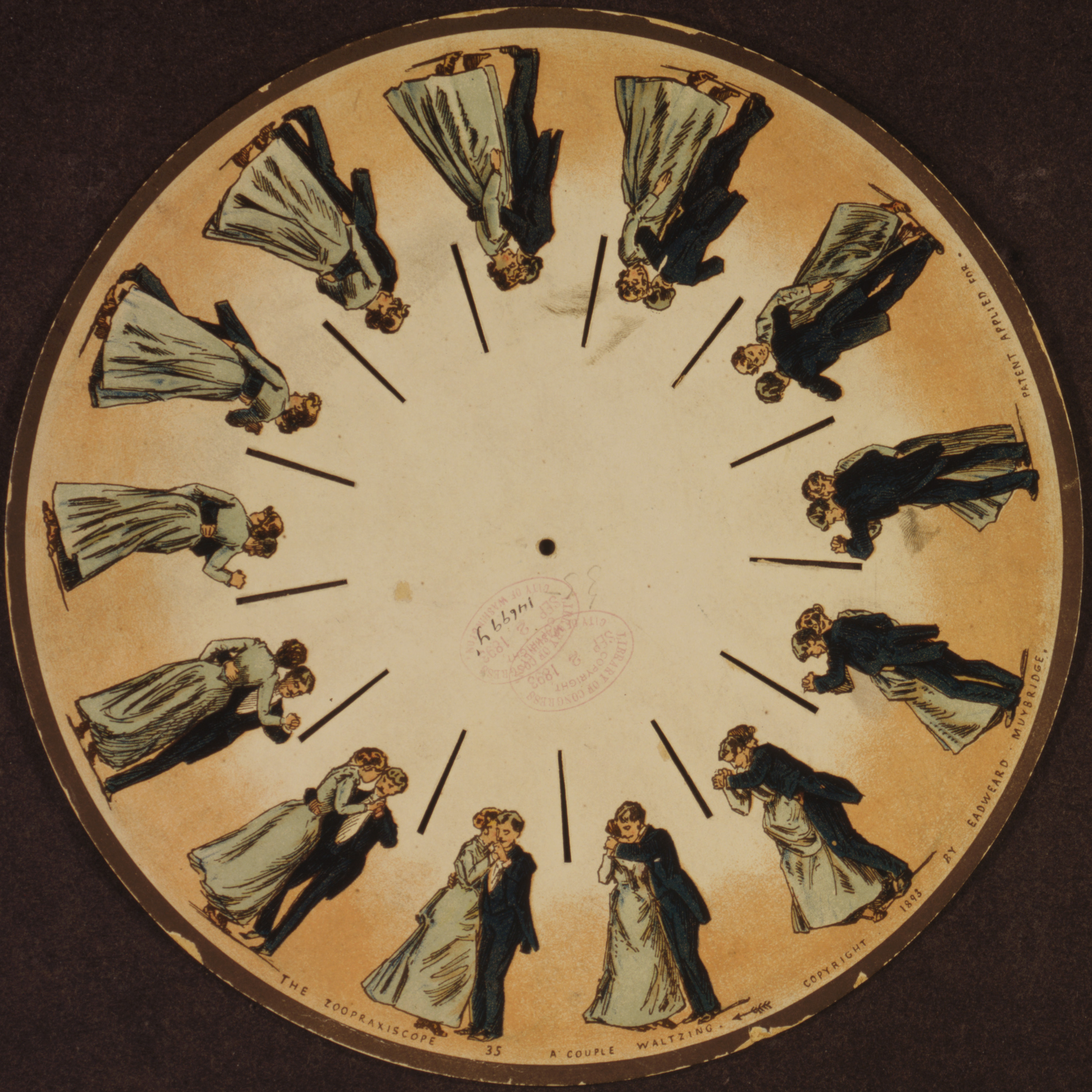
Shortly after the creation of the Thaumatrope, the Phenakistoscope was created in 1831 by both Joseph Plateau and Simon von Stampfe. The Phenakistoscope was the first early use of 'animation' that was able to feature more than two pictures. The device was a disc, in which a series of pictures were drawn on by hand evenly. Slits were then cut in the device in between each picture, then held in front of a mirror and spun.
 |
| A Phenakistoscope in use |
 |
| Birds eye view shot of the device |
 |
| A Zoetrope with several slides |
Based off the Phenakistoscope, the Zoetrope was created nine years later in 180AD by William George Horner. The device would have a series of pictures with slits in them, much like the Phenakistoscope, but was curled and placed within a spinning device. After being placed, the device was then spun and one would look through the slits of the device to see the illusion of motion. I feel the Phenakistoscope shows a development through 2D history - as each major device is using aspects from the previous device created prior.
 |
| A Flipbook |
In 1868, a famous use of early 2D animation, which is still used today, was created. The Flipbook - was created by John Barnes Linnett, who originally dubbed his invention a 'kineograph'. The method does not require a device to work, which was the first of its kind, but is instead created and viewed by drawing many pictures on the bottom of a paper (commonly a notepad) and is then 'flipped' from the start to the finish to visualise a 2D animation.
 |
| Emilie Reynaud |
In 1877, the Praxinoscope was created by Emilie Reynaud - who created the device using influences from the Zoetrope - which I feel inspired the Parxinoscope, showing a development in 2D animation history, and the Phenakistoscope. The device was designed much like the zoetrope but had a mirror on the inside of the device which would reflect into the eye of a projector. Years later in 1888, Reynaud developed the Théâtre Optique, which which ultimately an extension to the Praxinoscope. Due to the Optique, Reynaud had invented a way of screening his animation to the public and in 1892 he showed his first animation 'Pauvre Pierro' -which was very well received by audiences. Reynaud's animations were the first early example of the 'drawing-on-film animation' method.
 |
| Praxinoscope & Théâtre Optique in use |
 |
| A Cinematograph |

More than 10 years after creating the light bulb, famous inventor Tom Edisson created a motion-picture device called the 'Kinetoscope' in 1893. Large and bulky, the Kinetoscope was created using a continuously moving loop of film over a light source with a rapid shatter. Although groundbreaking, the device required one to look through a peephole - thus limiting the viewing of the animation to one at a time.
After viewing a demonstration of the Kinetoscope and being handed a piece of its film, Louis and Augustine Lumiere were inspired to create their own groundbreaking animation device. In 1895, the brothers finally created what they called a 'Cinématograph', which was formed using the idea of a camera, a printer and a projector in one. Like the praxinoscope, the single device allowed a group of people to watch animations at one single time. Soon after the device boomed in popularity, the brothers started opening theatres to show their films in - which ultimately became cinema's.
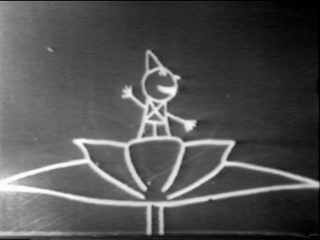
In 1899, Stop Animiation was created by Stuart Blackton and Albert E Smith. The 2D animation method consisted of an object being moved slightly, then a picture being taken each time thus forming an animation when all the pictures were put together. Today in the 21st century, this method of animation is still used today in animations such as Wallace and Gromit and South Park, which also uses a famous method called 'Cut-out' animation.
 |
| Cohl's 'Fantasmagorie' |
 |
| Gertie the Dinosaur & McCay during the end of the animation |
 |
| Rotoscoping - a-ha's 'Take On Me' |

A year later in 1915, Max Fleisher invented Rotoscoping. This type of animation is created by drawing over film clips frame by frame so when the film is played, it it seen as animation. To test the idea, Fleisher traced over footage of the Empire State Building - but today, the technique is still being used, a famous example being a-ha's music video for their song 'Take On Me' (see above).
 |
| Process of Rotoscoping in the 21st Century |
 | |
| Walt Disney |
The Golden Age of Animation
Walt Disney
In 1923, young animator Walt Disney had just gone bankrupt after his studio 'Laugh-O-Grams' was shut down. Soon after, Disney opened a new studio in Los Angeles. After a series of unsuccessful animations such as Disney's 'Alice Comedies' series. Disney saw a breakthrough in his company after creating 'Steamboat Willie', which was the first animation to have synchronised sound alongside the 2D animation. Alongside this, although it was the third official appearance of Micky Mouse, it is widely regarded as the first and the character subsequently went on to become one of the most famous cartoon characters in animation history. Soon after this, Disney released 'Flowers and Tree's in 1932 which was the first to use the three-colour Technicolour method - which won Walt his first Academy Award. After many more years of animating, Disney created the 'storyboard' which he used profusely during the creation of 'Snow White and the Seven Dwarfs'. Snow White was released in 1937 and is widely known as the first feature length animated film. The film was created using Technicolour cell animation - which Disney continued to use in his many other animated features later to come. One of the most interesting things people don't know about Walt Disney, is how much work he put into each frame of the animation - drawing each frame which were put together to create a full running animation. I feel this idea was inspired by the Zoetrope, which was a series of images put together and which was then spun - both with the same technique. Subsequently, many of today's animators are influenced by Walt Disney's technique 'Cell Animation' - using graphics tablets to modernise with today's technology. Today, Disney still holds the record for the highest grossing traditional animated feature - 'The Lion King' (1994) which grossed $961,473,777 worldwide. Aside from hugely successful feature films, Walt Disney has also created many of the most famous animated characters such as Mickey Mouse, Donald Duck and Goofy. Throughout animation history, Mickey Mouse has been one of the most famous animation characters during all the different changes during animation history. For example, many current animators even use the 'Mickey Mouse' character look on their own characters - knowing that there will be a higher chance their character will be popular due to Walt Disney and Mickey Mouse. An example of this is Walt Disney's production '101 Dalmations' - due to the fact the drawing technique used to draw the Dalmatians face's has been used in many different animations today.

 |
| Snow White and the Seven Dwarfs - 1937 |
Warner Brothers
In 1930, Disney saw a threat to their huge popularity when Warner Brothers Cartoons was founded by four brothers - Harry, Albert, Sam and Jack Warner. Whilst Disney was under the influence of Walt, Warner Bro's often allowed their animators to draw freely, to a limit, to add a personal style to their cartoons. In 1934, Warner Bro's released 'Honeymoon Hotel' which was the animation studio's first colour film and part of the popular 'Merry Melodies' series. With animators such as Tex Avery, Warner Bro's pursued a more adult based target audience with the creation of Looney Tunes, which saw the appearances of famous characters ranging from Bugs Bunny to Daffy Duck. These characters were often very cynical and slapstick was involved - often dubbing the cartoons not as suitable for children as Disneys current 'happy' animations at the time such as Dumbo.
 |
| Looney Tunes, with characters such as Bugs Bunny, Porkie Pig, Tweety Pie and Daffy Duck |
Len Lye
 |
| 'Love on the Wing' |
Norman McClaren
As well as Lye, McClaren also was lesser known at the time compared to larger animation studios. McClaren was famous for his drawing directly onto film with pen, which was infact created by Harry Smith. McClaren went on to create the likes of 'Love on the Wing' (1937), 'Dots' (1940) and 'Blinkity Blink' (1958).
Hanna-Barbera
After colour television was released in the United States in 1951, 2D animation had a new platform. Once short animation reels at the cinema were now played on television on Saturday mornings. In 1957, Hanna-Barbera was created by William Hana and Joseph Barbera and a year later, in 1958, they released the first half-hour television programme to only feature animation - Huckleberry Hound. As well Hound, Hanna-Barbera also had a series of hit animated shows such as Tom & Jerry, Scooby-Doo and The Flintstones, which was the first animated series on prime time television. Years later in 1996, Hanna-Barbera eventually formed together with rivals Warner Bros which continues today.
 |
| The Flintstones - Barney and Fred |
 |
| Monty Python's Flying Circus using Cut-Out Animation |
Throughout the years, 2D animation continued to develop and progress into a large chunk of television. During the 1960's many influential animation arose such as a large use of 'cut-out' animation, as mentioned earlier, such as Monty Python. Monty Python's Flying Circus often contained short animations created by Terry Gilligam, which often were 'random' yet surprisingly funny. In 1968, Yellow Submarine was created and was groundbreaking at the time for it's use of Rotoscope and psychedelic look - using bright colours.
 |
| Hayao Miyazaki |
Anime
The first anime film was created in 1945 called 'Momotoro's Divine Sea Warriors'. Japanese director Mitsuyo Seo created the animation to support the Japanese Naval Ministry during World War 2. Throughout the years, anime became increasingly popular after animator 'Hayao Miyazaki' founded 'Studio Ghibli' which saw a breakthrough in anime films such as 'Spirited Away'. Alongside films, many Japanese anime television programmes gained popularity in the United States - most notably 'Pokémon', which was adapted from the video game series of the same name.
The Future of Animation
 |
| Toy Story |
 |
| Jurrasic Park |
Bibliography
Robert Vaux. (2013). The History of 2D Animation. Available: http://www.ehow.com/about_6394473_history-2d-animation.html. Last accessed 19th October 2013.
Joshua Mosley. (2013). Animation History Timeline.
Available: http://www.joshuamosley.com/UPenn/courses/Ani/AnimationHistory.html.
Last accessed 19th October 2013.
TimeToast. (2012). History of 2D Animation. Available: http://www.timetoast.com/timelines/history-of-2d-animation. Last accessed 13th January 2014.
Wikipedia. (2013). Animation. Available: http://en.wikipedia.org/wiki/Animation. Last accessed 13th January 2014.
Wikipedia. (2013). Looney Tunes. Available: http://en.wikipedia.org/wiki/Looney_Tunes. Last accessed 14th January 2014.
Wikipedia. (2013). Walt Disney. Available: http://en.wikipedia.org/wiki/Walt_Disney. Last accessed 14th January 2014.
http://www.youtube.com/watch?v=6PgNr0IZRDE - Len Lye, 'A Colour Box'
http://www.youtube.com/watch?v=S1qD3gfk4QI - Norman McLaren, 'Love on the Wing'
http://www.youtube.com/watch?v=djV11Xbc914 - A-ha, 'Take On Me'
http://www.youtube.com/watch?v=UY40DHs9vc4 - Windsor McCay, 'Gertie the Dinosaur'
TimeToast. (2012). History of 2D Animation. Available: http://www.timetoast.com/timelines/history-of-2d-animation. Last accessed 13th January 2014.
Wikipedia. (2013). Animation. Available: http://en.wikipedia.org/wiki/Animation. Last accessed 13th January 2014.
Wikipedia. (2013). Looney Tunes. Available: http://en.wikipedia.org/wiki/Looney_Tunes. Last accessed 14th January 2014.
Wikipedia. (2013). Walt Disney. Available: http://en.wikipedia.org/wiki/Walt_Disney. Last accessed 14th January 2014.
Team Ghiblink. (2013). Hayao Miyazaki. Available:
http://www.nausicaa.net/miyazaki/miyazaki/. Last accessed 14th January 2014.
Wikia. (2014). Hanna-Barbera . Available:
http://hanna-barbera.wikia.com/wiki/Hanna-Barbera_Wiki. Last accessed 14th
January 2014.
http://www.youtube.com/watch?v=6PgNr0IZRDE - Len Lye, 'A Colour Box'
http://www.youtube.com/watch?v=S1qD3gfk4QI - Norman McLaren, 'Love on the Wing'
http://www.youtube.com/watch?v=djV11Xbc914 - A-ha, 'Take On Me'
http://www.youtube.com/watch?v=UY40DHs9vc4 - Windsor McCay, 'Gertie the Dinosaur'
Wikipedia. (2013). Pixar - Disney. Available:
http://en.wikipedia.org/wiki/Pixar#Disney. Last accessed 14th January 2014.


No comments:
Post a Comment